
Deck-Seam Loss Factors
Evaluating the usefullness of eck seam loss factors for modern floating roofs
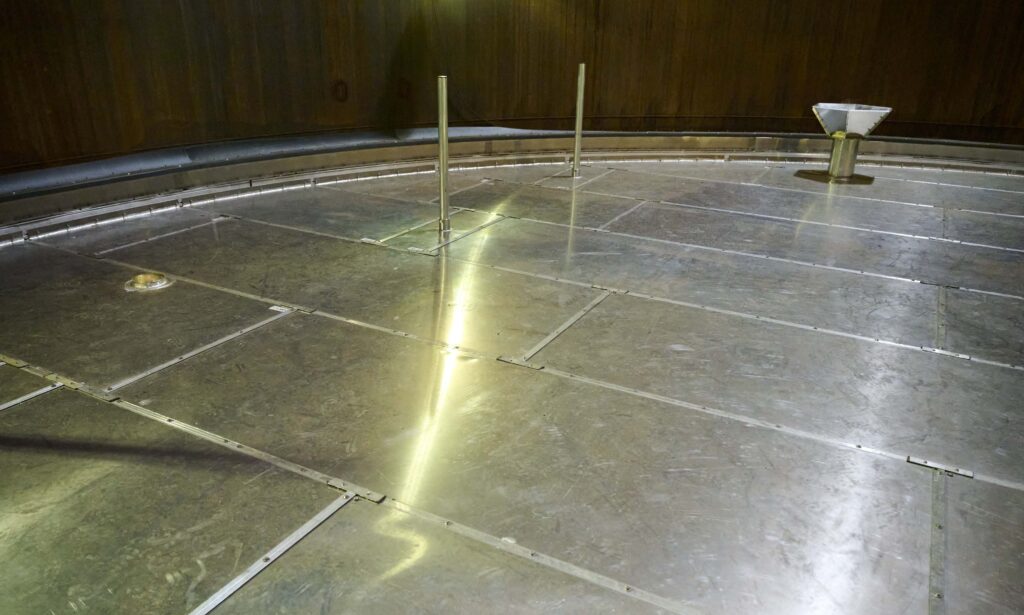
Are We Using the Right Physical Model for Modern Full-Contact IFRs?
Why a legacy loss-factor framework can become less representative when the underlying technology changes
Abstract
Deck-seam loss factors are embedded in established storage-tank emission calculation methods. They are useful parameters, but they are not neutral to roof architecture. The historical data reproduced in the source material gives an average deck-seam loss factor of 0.054 lb-mol/ft-yr for non-contact decks and 0.23 lb-mol/ft-yr for contact decks – a factor of approximately 4.3 higher for the contact category. Taken at face value, this can create the impression that a full-contact roof has intrinsically worse deck-seam performance than a non-contact roof.
That comparison overlooks a more fundamental issue: the two roof concepts control emissions through different physical mechanisms. A non-contact roof contains vapour that has already formed beneath a deck suspended above the liquid. A full-contact roof is intended to remove the continuous vapour space beneath the deck and therefore reduce the area from which vapour can form. The importance of a seam is consequently not determined only by a loss factor per unit seam length; it also depends on the liquid area capable of feeding that seam, the actual roof geometry, and whether the installed roof is truly full-contact in service.
The project source material also reports modern panel-to-panel full-contact seam values around 0.0081 and 0.0063, far below the generic historical contact value. The purpose of this paper is not to declare standards ‘wrong’, nor to claim that every full-contact roof outperforms every non-contact roof. It is to ask a narrower and more important engineering question: whether a loss-factor framework developed from an earlier generation of roof technology is sufficiently representative when applied to modern full-contact designs.
Key findings
- The historical generic data reproduced in the source material assigns the contact-roof category an average seam factor about 4.3 times the non-contact average.
- A deck-seam loss factor measures loss per unit seam length; it does not by itself describe the vapour-generation area beneath the deck.
- Non-contact and full-contact roofs should therefore not be compared on seam factor alone.
- The term full-contact should describe the physical configuration, not merely a product label: significant non-contact areas can materially change the mechanism.
- Modern seam designs and later test results reported in the source material indicate that the historical generic contact value may not represent current panel-to-panel technology.
- Laboratory certification is necessary evidence, but field constructability, sealant dependence, ageing and inspection determine whether test performance is reproduced in service.
- A more representative assessment should combine roof architecture, exposed liquid area, seam-specific data, rim/fitting losses and lifecycle verification.
| Central thesis: A methodology can remain mathematically consistent while becoming physically less representative when the technology to which it is applied has changed. |
1. The question behind the number
Emission calculations need standardised inputs. Deck-seam loss factors fulfil that role by expressing a loss rate per unit length of deck seam. The attraction is obvious: the factor is measurable, comparable and can be incorporated into a repeatable calculation. The difficulty begins when the factor is treated as if it were a complete measure of internal floating roof efficiency.
It is not. A seam is a pathway. Emissions through that pathway still depend on what vapour source exists beneath or adjacent to it. Two roofs can have the same total seam length and even the same measured seam factor while presenting very different evaporative conditions. If one roof has a continuous vapour space beneath almost the entire deck and another has liquid in direct contact with almost the entire underside of the deck, the physical source feeding the seam is different.
The central question is therefore not simply ‘what is the Kd value?’ but ‘what physical situation does that Kd value represent?’ That distinction becomes decisive when comparing non-contact and full-contact IFRs.
2. Two roof concepts, two emission mechanisms
2.1 Non-contact roofs: contain vapour after it has formed
In a conventional skin-and-pontoon or other non-contact IFR, the deck skin is supported above the product. A continuous or near-continuous vapour space exists beneath the deck. Product evaporates into that space until the local vapour approaches equilibrium. The roof reduces emissions by containing that vapour and limiting exchange with the tank vapour space above the roof.
When vapour escapes through seams or openings, the vapour space is replenished by further evaporation from the liquid surface below. The seam therefore connects to an evaporative source that may extend over a large area of the tank. Seam tightness is consequently important not only because vapour can pass through a gap, but because the gap can communicate with a large saturated vapour volume.
2.2 Full-contact roofs: reduce vapour formation at source
A true full-contact roof works differently. The deck is intended to remain in direct contact with the product over essentially the whole usable deck area. That removes the continuous vapour space beneath the roof. Vapour formation is then concentrated at local discontinuities: panel seams, fittings, penetrations, rim areas and any portions of the roof that are not actually in contact with the liquid.
This does not make a full-contact roof emission-free. It changes the geometry of the source. The distinction is critical: the effectiveness of a seam can no longer be interpreted independently from the width and area of liquid exposed to that seam and from the extent of non-contact zones elsewhere in the roof.
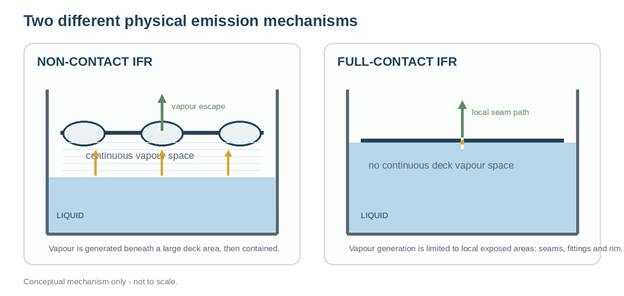
Figure 1 – Conceptual difference between the emission mechanisms of non-contact and full-contact IFRs.
| Engineering implication: A seam factor is a property of a leakage path. Roof performance is a property of the complete vapour-generation and containment system. Those are not the same thing. |
3. What the historical data actually says
The project source paper reproduces an analysis from API MPMS Chapter 19.2 Appendix I. The underlying test programme included tank tests and test-cell work for both non-contact and contact deck seams. The results were averaged into generic deck-seam loss factors.
| Deck category | Test assembly | Reported Kd (lb-mol/ft-yr) |
| Non-contact | 20-ft test tank | 0.12 |
| Non-contact | Large test cells – 2 seams per pan | 0.053 |
| Non-contact | Large test cells – 6 seams per pan | 0.030 |
| Non-contact | Small test cells – 5 seams per pan | 0.011 |
| Non-contact | Average reported | 0.054 |
| Contact | 20-ft test tank | 0.57 |
| Contact | Large test cells – 6 seams per pan | 0.13 |
| Contact | Small test cells – 5 seams per pan | 0.11 |
| Contact | Private manufacturer test – 1 seam | 0.12 |
| Contact | Average reported | 0.23 |
On these averages, the generic contact value is approximately 4.3 times the generic non-contact value. The same reproduced analysis notes that later fugitive-emission testing returned values of 0.047 for a non-contact deck and 0.35 for a contact deck, again placing the contact value materially higher.
This is an important result, but it must be interpreted correctly. The tests determine loss through the seam configuration under the test conditions. They do not establish that a complete contact roof must emit more than a complete non-contact roof. That broader conclusion would require the roof-level vapour-generation mechanism and the area feeding each leakage path to be comparable – which they are not.
3.1 The historical context matters
The original paper places the development of deck-seam loss factors in the early 1990s, when non-contact aluminium IFRs were prevalent and modern panel-to-panel full-contact technology was still emerging. The references embedded in the source material show that key deck-seam work was undertaken between 1994 and 1996, followed by a testing-protocol report in 1999. The EPA AP-42 background document cited in that material was issued later, in 2006.
That history does not invalidate the work. It defines its technological context. Generic factors are necessarily a representation of the products, test articles and questions available at the time. When roof architecture changes materially, the engineering question becomes whether the inherited factor still represents the new architecture closely enough for comparative decisions.
| What this paper does not claim: There is no basis in the source material to attribute the historical factors to anti-competitive intent. The technical criticism stands without that claim: the test population and calculation framework came from an earlier technological landscape. |
4. Why a seam factor can mislead when the physical model changes
The problem is easiest to see by separating three quantities that are often collapsed into one discussion: (1) the amount of liquid surface able to generate vapour, (2) the path available for vapour to escape, and (3) the resistance or tightness of that path.
For a non-contact roof, the first quantity can approach the full tank surface area beneath the suspended deck. For a panel-to-panel full-contact roof, the first quantity is intended to be limited to very narrow seam interfaces and discrete fittings. The seam loss factor primarily characterises the third quantity. It cannot, on its own, represent the difference in the first quantity.
This is why a counter-intuitive numerical result can arise: a non-contact seam may receive a lower generic Kd than a contact seam, while the non-contact roof still offers a much larger vapour-generation area. If Kd becomes the dominant comparison criterion, the calculation can give disproportionate weight to the pathway and insufficient weight to the source feeding that pathway.
The original source paper illustrates this with a practical comparison. For a 36 m gasoline tank, it reports that the difference between two modern panel-to-panel seam factors of approximately 0.008 and 0.006 corresponds to only about 20 kg/year, whereas a comparable seam-factor difference applied to a non-contact configuration was calculated to have an effect roughly 90 times larger under similar operating assumptions. The exact result depends on the calculation inputs, but the direction of the argument is important: architecture governs the significance of the seam factor.
5. “Full contact” must be a physical condition, not a label
Not every roof marketed or classified broadly as full-contact eliminates the vapour space to the same degree. The project design-review material includes an example in which substantial rim and structural areas were not in contact with the liquid; the review estimated the non-contact portion at approximately 17 percent and concluded that the roof should not be treated as full-contact for emission-calculation purposes.
That observation is central to a better model. A roof should be evaluated on the actual area that is in liquid contact, the geometry of panel-to-panel joints, the size of rim zones, and the treatment of appurtenances. Girder-supported arrangements that create recurring vapour pockets between panels are physically different from panel-to-panel arrangements with almost no separation between adjacent buoyant modules.
A useful classification should therefore describe the mechanism: how much continuous vapour space exists beneath the deck, where exposed liquid remains, and how those exposed areas communicate with seams or fittings. A binary product label is not enough.
6. Technology has moved faster than the generic factor
The source paper reports later measured deck-seam loss factors of approximately 0.0081 for a panel-to-panel roof tested in 2006 and 0.0063 for a later design tested in 2022. Both values are far below the historical generic contact average of 0.23 reproduced from Appendix I. Numerically, 0.23 is about 28 times 0.0081 and about 36 times 0.0063.
Those ratios should not be used carelessly: the tests were not necessarily identical in configuration, protocol, workmanship or boundary conditions. They do, however, make one point difficult to ignore. Modern full-contact seam technology can occupy a performance range that is remote from the historical generic contact factor.
The more important development is not simply the lower laboratory value. Modern panel-to-panel concepts can also reduce the dependence on long runs of field-applied caulking by using mechanical engagement, compressed elastomeric gaskets or O-ring type seals. That matters because the probability of reproducing the laboratory condition over the full installed seam length is a lifecycle issue, not just a test issue.
7. Laboratory Kd versus installed performance
A deck-seam test intentionally isolates the joint so that a repeatable loss factor can be measured. That is necessary for comparison, but it creates a controlled environment: clean surfaces, known assembly sequence, careful sealant application where applicable and defined test conditions. A tank installation is different. Thousands of metres of joints may be assembled under schedule pressure, inside a tank, with variable access and tolerances.
A design that needs perfect caulking to reproduce its certified value carries a different field-performance risk from a design in which sealing pressure is generated mechanically along the seam. This does not mean that gaskets are automatically superior in every service. Material compatibility, compression, ageing and inspection remain essential. It means that constructability and error sensitivity belong in the performance assessment.
The same applies over time. Elastomers age; sealants can shrink, crack or debond; panels can move; roof geometry can change; fittings can be modified. A laboratory Kd is therefore best understood as an initial performance characteristic of a joint under defined conditions, not as a lifetime guarantee for the installed roof.
8. A more representative assessment framework
A stronger method does not require abandoning deck-seam loss factors. It requires placing them in the correct hierarchy. For a modern IFR, the following questions should be answered in sequence:
1. Classify the roof by physical mechanism. Determine whether the deck is genuinely full-contact, partially contact or non-contact in service. Identify continuous vapour spaces, not just the vendor category.
2. Quantify non-contact and exposed liquid areas. Include rim zones, girders, panel gaps, wells, legs, columns, gauge poles and other appurtenances. A small nominal seam width and a large non-contact rim area should not be treated as equivalent issues.
3. Characterise the actual seam geometry. Review whether adjacent panels meet directly or are separated by structural members, whether the joint is gasketed, mechanically compressed, caulk-dependent or welded, and whether T-joints and terminations create additional paths.
4. Use representative seam data. Where a tested Kd exists for the actual joint, test method and assembly, use that value rather than a generic historical factor – subject to the governing calculation method and regulatory acceptance.
5. Assess field reproducibility. Consider tolerances, assembly sequence, accessibility, inspection, reliance on workmanship and the consequences of local defects over the total seam length.
6. Treat rim and fittings separately. Deck seams are only one emission pathway. Rim-seal performance and deck fittings can dominate if poorly designed or maintained.
7. Verify in service. Link design performance to commissioning checks, inspection, condition assessment and, where appropriate, measurement. Design efficiency is not automatically in-service efficiency.
8.1 Decision matrix
| Assessment item | Non-contact IFR | Full-contact IFR | Engineering consequence |
| Continuous vapour space beneath deck | Large / inherent | Minimal if genuinely full-contact | Defines vapour-generation source |
| Importance of seam pathway | High | Still important, but localised | Must be related to exposed liquid area |
| Generic historical Kd | May be useful as default | Can be unrepresentative for modern joints | Prefer representative tested data where accepted |
| Sensitivity to non-contact zones | Already inherent in concept | Potentially decisive | Verify rim, girders and fittings |
| Field sealing dependence | Design-specific | Design-specific | Assess caulk/gasket/mechanical compression |
| Lifecycle verification | Required | Required | Inspect actual condition, not only design intent |
9. Implications for standards, BAT and procurement
Standards need generic values because not every project has type-specific test data. Generic values are therefore valuable defaults. The problem arises when a default becomes a proxy for technical merit after the underlying products have diverged from the population on which that default was based.
For BAT assessment and procurement, a lower or higher published Kd should not be read in isolation. A purchaser should ask whether the tested joint represents the supplied roof, whether the roof is genuinely full-contact over the relevant area, how the seam is sealed, how terminations are treated, how much non-contact area remains, and how the result can be verified after installation.
This also changes the role of certification. A certificate should be an input to engineering judgement, not a substitute for it. The strongest evidence chain is: representative test method -> representative joint -> constructible detail -> verified installation -> maintained in-service condition.
9.1 What an updated methodology should aim to do
- Separate roof architecture from seam tightness instead of allowing one generic seam factor to carry both ideas.
- Distinguish genuinely full-contact panel-to-panel roofs from hybrid or girder arrangements with material non-contact areas.
- Allow current, independently tested seam factors to replace historical generic values when the test and supplied detail are demonstrably equivalent and the governing framework permits it.
- Account explicitly for exposed liquid area and local vapour pockets.
- Retain separate treatment of rim seals and fittings rather than using deck performance as a proxy for total roof performance.
- Incorporate commissioning and in-service verification so that calculated performance is linked to actual condition.
10. Conclusion
Deck-seam loss factors remain useful. The technical problem is not the existence of the factor; it is the assumption that a factor developed from one generation of roof technology can always be transferred without loss of meaning to another.
The historical dataset reproduced in the project source material gives the contact-deck category a materially higher generic Kd than the non-contact category. That result can be valid for the tested seams and still be a poor basis for ranking complete roof concepts, because full-contact and non-contact roofs do not present the same vapour source to those seams. One principally contains vapour formed beneath a suspended deck; the other is intended to prevent formation of that continuous vapour space by contacting the liquid.
Modern panel-to-panel full-contact technology further widens the gap between the historical generic category and current practice. Later values reported in the source paper are one to two orders of magnitude below the historical contact average. More importantly, modern joint designs can reduce exposed liquid area and reduce dependence on field-applied sealants.
The right response is not to dismiss established calculation methods. It is to use them with engineering context. Roof architecture, actual contact area, seam geometry, representative test data, constructability and lifecycle condition should be considered together. Only then does a deck-seam loss factor become what it should be: one parameter in a physical model of the tank, rather than the model itself.
| The question for the industry: Are we comparing modern full-contact IFRs with a model that represents how they actually control vapour – or with a legacy category that survives because it is easy to calculate? |
Source notes and publication verification
This draft is a technical synthesis of the Emission Zero project source material. It deliberately separates the engineering argument from supplier advocacy. Before public release, current standard editions, clause numbering, test-certificate provenance and exact bibliographic details should be checked against the original publications.
[1] Robin Essenius, Deck seam loss factors and deck seam design for full contact roofs – Backgrounds and explanations, 1 June 2024.
[2] API MPMS Chapter 19.2, Appendix I, Fourth Edition (2020), as reproduced and discussed in source [1].
[3] Chicago Bridge & Iron Technical Services Company, Loss Factor Measurements of Internal Floating Roof Deck Seams Using the Weight Loss Test Method, Interim Reports 1-7, prepared for the American Petroleum Institute Committee on Evaporation Loss Measurement, September 1994-October 1996 (reference reproduced in the source material).
[4] U.S. Environmental Protection Agency, Emission Factor Documentation for AP-42 Section 7.1 Organic Liquid Storage Tanks, Final Report, September 2006 (reference reproduced in the source material).
[5] Petrex, Inc., Test for Vapor Loss Through Clamp Bars Used on Petrex Internal Floating Roof System, prepared by Petrex, Inc., March 5, 1984 (reference reproduced in the source material).
[6] Chicago Bridge & Iron Company, Development of the Testing Protocol for the Measurement of Deck Seam Loss Factors Using the Fugitive Emission Test Method, Final Report, prepared for the American Petroleum Institute Committee on Evaporation Loss Estimation, September 14, 1999 (reference reproduced in the source material).
[7] EEMUA 213, Appendix A (2015 edition), cited in source [1] as an alternative route for post-installation performance evaluation.
[8] Emission Zero project design-review material on full-contact classification, non-contact area and seam geometry, used as supporting engineering evidence.