Wax, Heavy Products and Floating-Roof Performance
Crude oil, fuel oil, condensates and other high-viscosity or high-pour-point products can leave wax or product film on the tank shell as a floating roof moves. The source tests show that this is more than a housekeeping issue.…
How shell deposits and product film affect seals, corrosion, drainage and emissions
Crude oil, fuel oil, condensates and other high-viscosity or high-pour-point products can leave wax or product film on the tank shell as a floating roof moves. The source tests show that this is more than a housekeeping issue. Deposits can interfere with seal contact, accumulate around foam dams, contaminate rainwater, accelerate pontoon corrosion and create slippery or combustible contamination on the roof. Wax management should therefore be integrated into seal design, inspection and product-change strategy.
Key points
- Wax on the shell can increase emissions by preventing consistent seal contact.
- Product scraped from the shell can accumulate between the seal and foam dam and obstruct drainage.
- Solar heating can remobilise product film left above a descending roof and cause later run-off onto the roof.
- A scraper must remain effective across shell welds and rim-space variation without damaging the seal.
- Open scraper geometry can reduce the risk that accumulated product disables the scraper itself.
Two deposit mechanisms
The source distinguishes solid wax fractions deposited on the shell from a more general product film left behind as the roof descends. The film can be solid at night or in cold weather and then liquefy under solar heating, running down onto the seal and roof after the operating event that created it.
Why deposits matter
Accumulated product can damage or lift secondary-seal elements, reduce shell contact, contaminate rainwater and block foam-dam drains. Trapped contaminated water then creates a persistent wet environment on the pontoon top plate and around the foam dam, increasing corrosion risk. Product on the roof also affects safe access and coating condition.
Scraper design objectives
- Remove as much residual product as practical without scoring the shell or overloading the seal.
- Follow the tank curvature with overlapping elements so untreated strips are minimised.
- Pass vertical and horizontal welds without permanent deformation.
- Remain effective at minimum, nominal and maximum rim gaps.
- Allow scraped material to escape rather than building up behind the blade.
- Position the scraping edge so seal rotation at welds does not simply lift it away from the shell.
What the test programme indicates
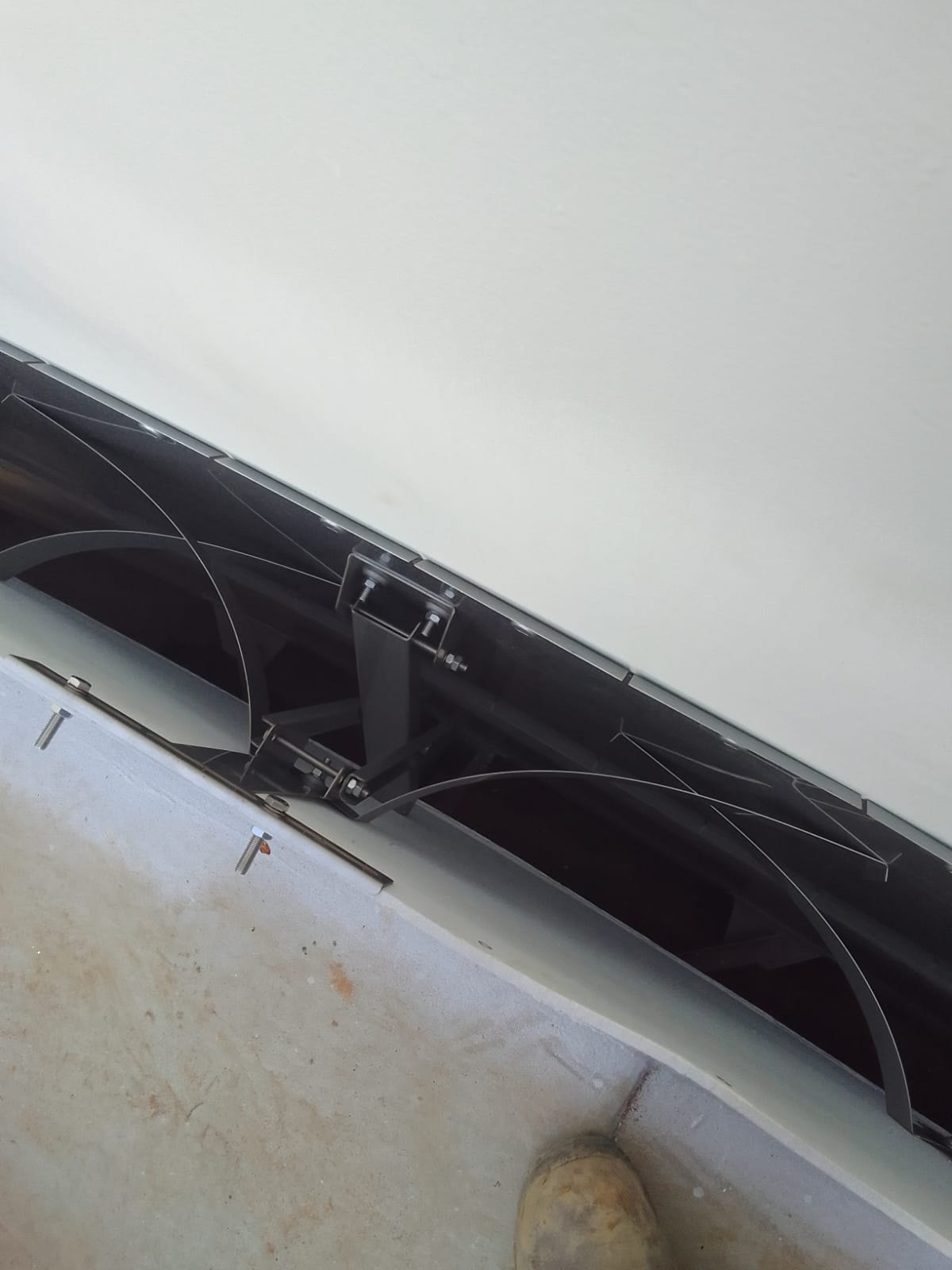
The archived mock-up tests compared different stainless-steel scraper thicknesses and geometries over deliberately aggressive welds and with petroleum jelly used to simulate deposits. Thinner high-strength spring material produced lower reaction forces while remaining effective. The tests also showed that a flush scraper could lose contact when the primary seal rotated over a weld, while a projecting scraper retained better scraping action.
Limits of the concept
No scraper can create a perfectly clean shell. Corrosion roughness, weld reinforcement and local distortion will always leave some residue. The correct objective is therefore risk reduction and controlled deposit management, not a claim of complete removal.
Inspection strategy
Inspect the shell-contact edge, scraper spring condition, attachment points, deposit escape paths, secondary-seal top surface, foam-dam drains and pontoon coating. If product run-off is observed, link the inspection to operating temperature, product pour point and roof travel history to identify the mechanism.
Conclusion
Heavy-product service creates a direct link between product properties, shell condition and emission-control hardware. Effective wax management can improve seal contact, drainage, corrosion control and safe access. The scraper should be treated as a dynamic mechanical component and verified under representative rim gaps and shell discontinuities.
Source basis and publication notes
This draft is a supplier-neutral synthesis of the project source material. Supplier-specific claims, branding and proprietary conclusions have been removed or reframed as general engineering considerations. No attempt has been made in this draft to update historical standards or regulatory references beyond what the source material itself states.
Principal source material
- wax scraper design.docx
- Whitepapers.zip — IFR suitability in crude oil service 20150914 UK rev 1.docx
- Whitepapers.zip — seal comparison.docx
Before publication: verify current editions and clause references for API, EEMUA, EN, NFPA, PGS and applicable local regulation; confirm any quantitative design limits against the project-specific code basis; and use project photographs only after branding/confidentiality review.